
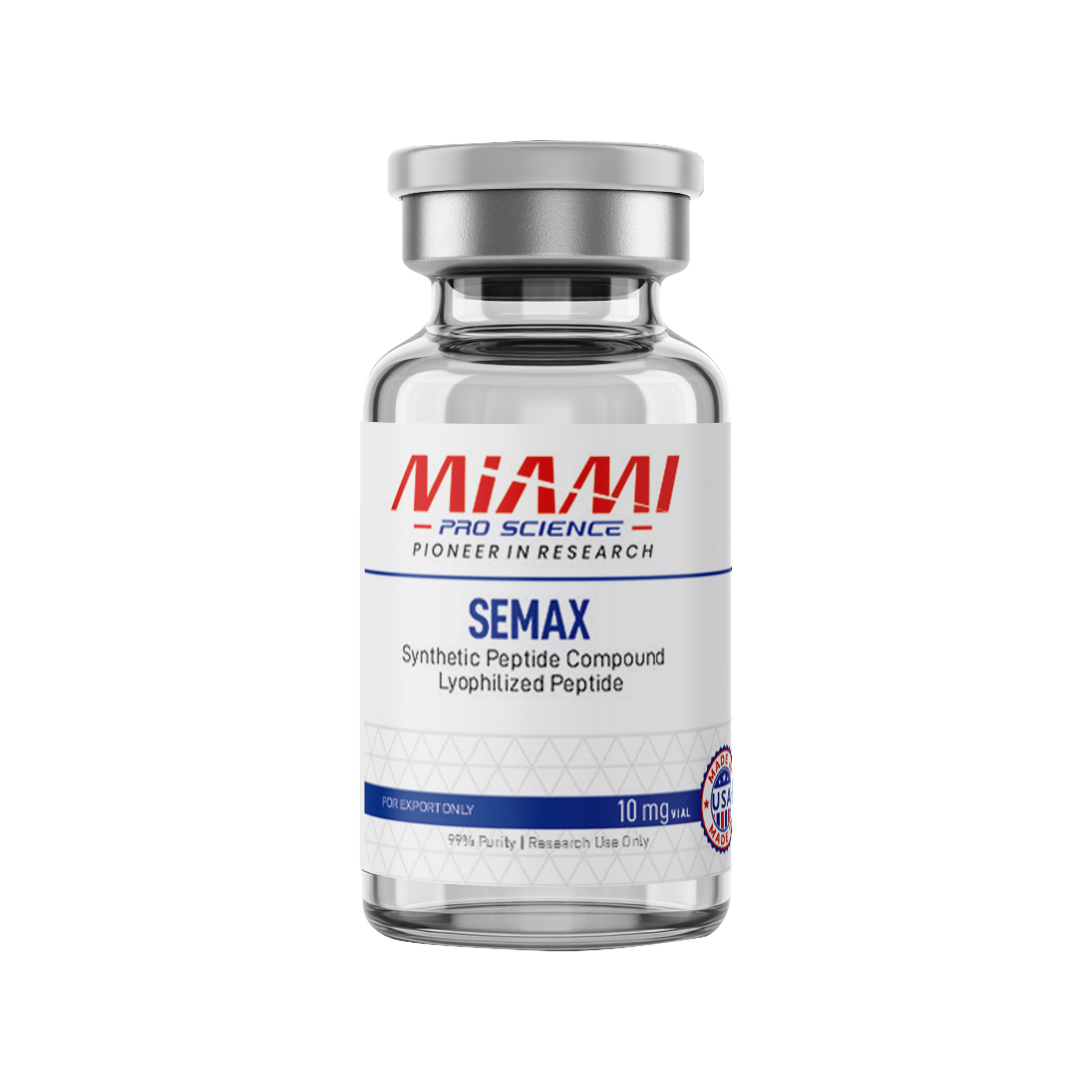
Semax is a synthetic nootropic and neuroprotective peptide derived from the ACTH hormone fragment. It is widely researched for its potential to support focus, memory, mental clarity, neuroprotection, cognitive performance, and BDNF activity without significant hormonal effects. Commonly studied in cognitive enhancement and neurological recovery research.
Semax is a synthetic heptapeptide developed from the adrenocorticotropic hormone (ACTH) fragment 4-10, with the amino acid sequence Met-Glu-His-Phe-Pro-Gly-Pro (MEHFPGP). Originally developed by Russian researchers, Semax has been extensively studied for its nootropic, neuroprotective, and neuroregulatory properties.
Unlike full ACTH, Semax was specifically engineered to retain cognitive and neuroprotective benefits while minimizing endocrine and cortisol-stimulating effects. This unique mechanism has made it one of the most recognized research peptides in the cognitive enhancement and neuroplasticity category.
Research suggests that Semax may influence several neurological pathways, including:
These mechanisms have led to extensive research involving memory, focus, learning capacity, mental clarity, mood regulation, and recovery from neurological stress.
Semax has also been researched in areas involving:
One of the major reasons for Semax’s popularity within nootropic research is that it is not considered a traditional stimulant. Instead of aggressively increasing neurotransmitter release, Semax is believed to support long-term neuroplasticity and cognitive regulation pathways.
Semax is commonly researched in intranasal form due to its rapid CNS accessibility and bioavailability. It has been approved and prescribed in Russia for neurological and cognitive applications, although outside Russia it remains primarily a research compound.
This product is intended strictly for laboratory and research purposes only. It is not approved for human consumption or medical use in many jurisdictions.
High-quality research-grade peptides and compounds engineered for scientific innovation and laboratory use.